

The headlines were alarming after the Pennsylvania Public Utility Commission released a report from Synapse Energy Economics showing that, unless policy changes are made, by 2030 growth in electricity demand, driven largely by data center development, will increase the probability of blackouts to nearly six times the level that managers of the region’s electric grid consider acceptable.
A spokesperson for PJM, the independent system operator (ISO) that manages the grid in thirteen states and the District of Columbia, concurred with the report’s findings.[1] Democrats and Republicans in the Pennsylvania legislature blamed each other for the sudden threat. Various observers and the report itself suggested PJM needs to speed the process for adding new generating capacity. And, even before the report was released, Pennsylvania Governor Josh Shapiro announced an executive order that encourages data centers to supply their own power and capacity rather than rely on the grid to provide it.[2]
But, amid these expressions of concern, another possible reaction to the report was conspicuously absent. I could find no reported instance of anyone suggesting that Synapse’s report on reliability might itself not be reliable. No one, as far as I know, suggested that the report’s estimate of the risk of interruptions to service might be exaggerated. Yet, the possibility of exaggeration is not remote.
While it might be argued that overestimating demand is the cautious and prudent thing to do, it’s also the case that the PJM forecast incorporates a reserve margin of 20%, which exists specifically to address adequacy concerns. Meanwhile, if the forecast is exaggerated and policymakers, power generators, utilities, and regulators act on the report’s findings only to have the predicted level of demand growth fail to materialize, the potential negative consequences for the public are considerable.
That’s because, amid the current rush by utilities and data center developers to build more generating capacity, the capital cost of new, natural gas-fired power plants has in some cases more than tripled. For instance, the 1,875 MW Guernsey Power Station in Ohio, came online in 2023, at a cost of $1.7 billion or $907/kw.[3] By comparison, the just announced 3,750 MW East Riverside Energy Center in Fayette County, PA carries a capital cost of $13 billion or $3,467/kw.[4]
Not all new resources, generation and otherwise, will come from gas-fired plants, but much of it is expected to. Besides, the same demand crunch that is driving up the cost of gas-fired generation is also infecting other resources, although perhaps not to the same extent.
Levelized cost of energy ($/MWh)
In any case, the result is that, over a 30-year life span, all other things being equal, the cost of energy from the East Riverside facility will be nearly twice that of energy from the Guernsey Power Station. In fact, the annual cost of recovering just East Riverside’s capital expenditure will be greater than the entire annual operating cost of Guernsey.
Whether the market will bear that cost remains to be seen. But, whether it does or not, we now live in a world where the cost of bringing new power to the market will be similarly inflated, even if it’s in the noble pursuit of ensuring reliability. And the cost will fall on all of us.
That’s why we should aggressively question whether Synapse’s estimate of the growing risk of unreliability is accurate. Specifically, we should ask how likely it is that the level of load growth assumed in the Synapse study is exaggerated and, if so, by how much? And what does that mean for reliability risk and the cost of addressing it?
What we are facing
The Synapse findings are summarized in the following chart, which shows that, in the “reference” case, which reflects existing load growth expectations and the expected unfolding of events under current policy conditions, by the year 2030, loss of load events can be expected to arise at a rate of 5.9 times every ten years. That’s nearly six times more often than what PJM considers to be the acceptable probability of one loss of load event every decade.
Modeled PJM-wide resource adequacy for 2030
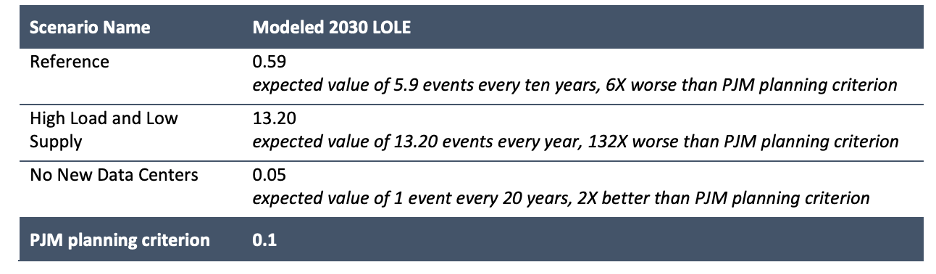
Source: Synapse Energy Economics
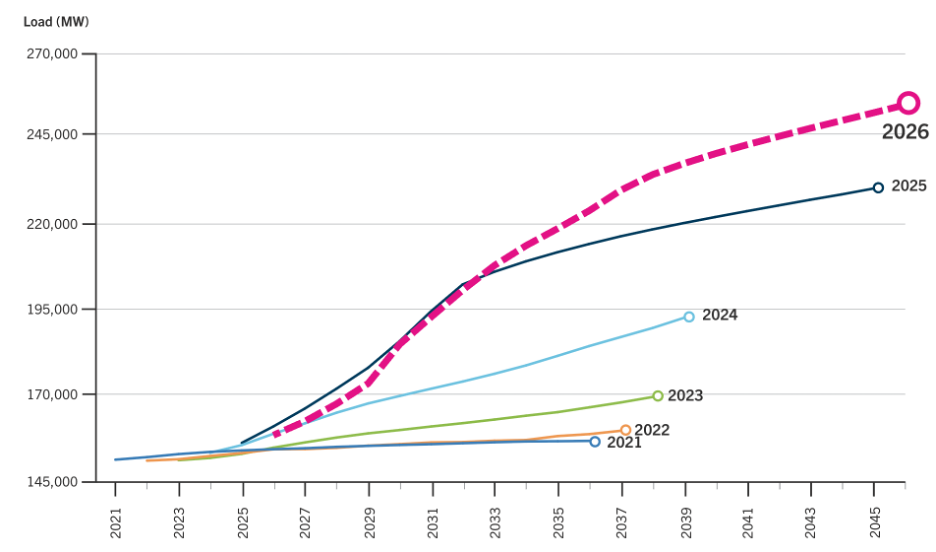
I should emphasize that the Synapse report’s authors did not come up with the demand scenario on which the report’s analysis is based. Those figures came directly from PJM’s load forecast, which projects a compound annual growth rate (CAGR) of 5.3% over the next ten years and 3.4% over a 20-year period.[5]
There is, however, a competing load growth forecast for PJM from Enverus Intelligence Research (EIR), a global energy analytics firm that serves more than 8,000 clients in 50 countries, including major utilities and power producers such as NextEra Energy, Vistra, and EQT. EIR, which examines economic fundamentals and not just risk aversion, foresees a much more modest increase.[6]
PJM Load Forecast Revisions vs. EIR Load Forecast
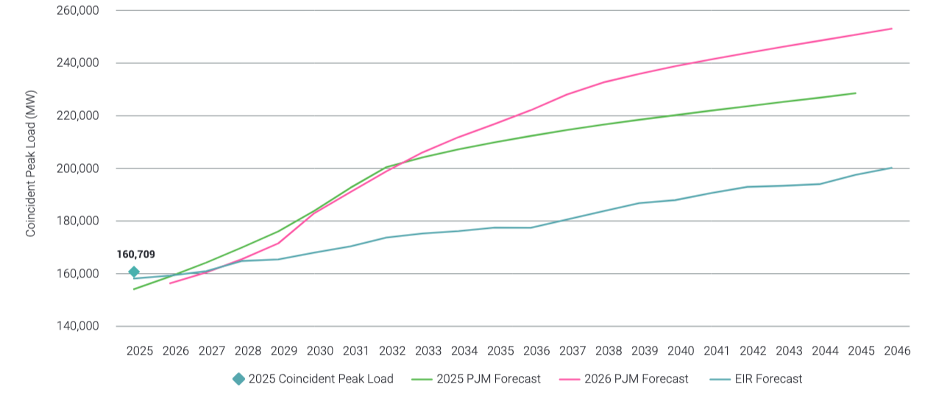
Source: Enverus Intelligence Research, PJM
Whereas PJM forecasts that coincident peak will rise from below 160,000 MW currently to over 250,000 MW by 2046, an increase of well over 50%, Enverus anticipates only half as much growth. And the divergence between the two forecasts is most pronounced in the next five years, when concerns about grid adequacy and reliability are the greatest.
While the differences between the PJM and EIR load forecasts may seem large, they really aren’t in light of year-to-year variations in PJM’s own forecasts. Recently, PJM’s long-term forecast has been revised by as much as 20% in the space of a single year.[7]
PJM RTO Summer Peak Demand Forecast
Source: PJM
PJM isn’t the only grid management organization to have its load forecast challenged by Enverus. Enverus also finds that ERCOT, the organization that manages the grid in Texas, is similarly overestimating demand in the face of expected increases in demand from data centers. This speaks to the uncertainty of the endeavor.
But Enverus isn’t the only expert organization to take issue with PJM’s load forecast. It has also been challenged by PJM’s own independent Market Monitor in regards to a planned capacity auction that PJM is undertaking to make up for a presumed shortfall in capacity for the 2028/2029 planning year. In its September 29th order, accepting PJM’s proposed Reliability Backstop Procurement auction to address an imminent shortfall in generating capacity, the Federal Energy Regulatory Commission (FERC) noted that:
The Market Monitor argues that PJM’s proposed 6,831 MW procurement target, based on the capacity shortfall recorded for the 2028/2029 BRA, is no longer correct because of changes in data center loads. The Market Monitor states that the data center load forecast for the 2028/2029 BRA was based on Load Adjustments received by PJM before September 5, 2025. The Market Monitor asserts that, since then, 4,017 MW of data center load, or 42% of the forecasted increase in the data center load between the 2026/2027 delivery year and 2028/2029 delivery year have been cancelled or delayed as of September 21, 2026. The Market Monitor contends that, after accounting for these data center cancellations and delays, the capacity shortfall for the 2028/2029 BRA should be reduced from 6,831 MW to 3,055 MW.[8]
So, while the PJM forecast on which Synapse’s calculation of Loss of Load Expectation (LOLE) is based may be accurate, the environment is highly volatile, providing considerable reason to suspect it might not be. And, if demand proves to be lower than expected, the probability of power interruptions will be lower as well.
Unfortunately, we don’t have access to all of the data necessary to precisely calculate what the PJM LOLE will be if load growth turns out to be more in line with EIR’s forecast than PJM’s. But, in very round numbers, it appears that the probability of loss of load would fall from Synapse’s 0.59 projection in the year 2030 to something in the neighborhood of 0.15, which is still greater than PJM’s 0.1 criterion, but more manageable and with much less effort and expense.
What the difference in scenarios will cost
The question, though, is how much additional cost does the higher PJM load forecast impose on customers? We know that, between 2026 and 2030, PJM anticipates over 100% of its load growth will come from large loads, nearly all from data centers, which is to say that demand for electricity from other sectors is actually expected to decline during the period. We also know from the Synapse study that, in the absence of data centers, PJM’s loss of load probability is just 0.5, well within the allowable standard for reliability.
Next, we know from the independent Market Monitor’s most recent analysis of PJM markets, which also relies on PJM’s load forecast, that anticipated data center demand is already adding $29.4 billion to customers’ utility bills between now and 2029.[9]
Impact of Data Center Load on Capacity Market Revenues

Source: Market Monitor
Finally, we know that, in the 2026-2030 window, PJM forecasts 27.3 GW of load growth as compared to the Enverus Intelligence Research forecast of just 17.2 GW, a difference of 10.1 GW, or 37%.
Again, because the relationship between load growth expectations, loss of load probabilities, and capacity market prices is not linear, it’s impossible to conclude exactly how much additional cost PJM’s load growth forecast imposes as compared to Enverus’ lower forecast. But we can safely say that the figure can be counted in the billions of dollars per year and that it will be paid by PJM customers.
Is that added cost necessary to assure that we maintain the acceptable level of reliability? The answer is, we really don’t know, although there is good reason to be doubtful.
What can be done?
In its recent order, FERC delayed PJM’s planned Reliability Backstop auction until February of next year in order to give the organization time to address what the commission found was PJM’s failure to show that its method for allocating costs resulting from the upcoming auction is “just and reasonable.” Also, without specifically criticizing PJM’s overall load growth forecast, FERC chairman Laura Swett also encouraged PJM to, “. . . employ the most up-to-date load and resource forecasts to inform the initial (procurement) target.”
In short, PJM has an opportunity to self-reflect and question its priors. At the same time, Pennsylvania’s PUC would be wise to ask the analysts at Synapse to explore a load growth scenario more like the one proposed by Enverus and, by doing so, prevent what could be expensive overreactions by policymakers and regulators.
While blackouts are legitimate concerns for customers of all kinds, they can also be leveraged to goad policymakers and regulators into actions that later prove to have been misguided. Going back to the 1970s, peoples’ fear of blackouts has been used to oppose the Clean Air Act, to perpetuate the burning of coal to generate electricity, and to oppose the development of wind and solar power. When backed into a corner, utility executives’ argument of last resort for almost any controversial project is, “Without it, when we flip the switch, the lights might not go on.”
Now, that same concern is being exploited again, this time to argue for more natural gas power plants, more pipelines, and more fracking. Little is being said about the cost or about the role alternative clean energy and demand-side resources might be able to play in addressing the issue. And virtually nothing is being said about the shaky evidence for the supposed risk of blackouts.
We should not allow ourselves to be bum-rushed into prematurely accepting what could be grossly inflated estimates of future electricity demand for which we will have to pay a steep price both in dollars and in impacts on the environment, our health, and our quality of life. Policymakers and regulators should not accept PJM’s load forecast at face value and they should hedge their strategies for dealing with load growth by prioritizing batteries, distributed generation, energy efficiency, and system utilization measures that are less expensive than new power plants and whose implementation can be more effectively calibrated in time and degree to demand growth as it emerges.
[1] Peter Hall, “Study warns of electricity shortages unless supply keeps pace with data center growth,” Pennsylvania Capital-Star, Sep. 16, 2026, https://penncapital-star.com/energy-environment/study-warns-of-electricity-shortages-unless-supply-keeps-pace-with-data-center-growth/
[2] Sophia Schmidt, “Data center growth drives blackout risk, Pa. PUC says,” WHYY, Sep. 15, 2026, https://whyy.org/articles/data-centers-blackouts-electricity-risk/
[3] Caithness Energy, LLC, “Caithness Energy Opens 1,875MW Guernsey Power Station,” Business Wire, Jun. 6, 2023, https://www.businesswire.com/news/home/20230606005867/en/Caithness-Energy-Opens-1875MW-Guernsey-Power-Station
[4] Joel Mairura, “$13bn East Riverside Energy Center Power Plant Coming to Fayette County, Pennsylvania,” Construction Review, Sep. 7, 2026, https://constructionreviewonline.com/13bn-east-riverside-energy-center-power-plant-coming-to-fayette-county-pennsylvania/
[5] PJM, “2026 PJM Load Forecast Report,” PJM, Jan. 14, 2026, https://www.pjm.com/-/media/DotCom/library/reports-notices/load-forecast/2026-load-report.pdf
[6] Enverus Intelligence Research, https://intelligence.enverus.com/research/180445
[7] PJM, “Planning – PJM Annual Report 2025,” PJM, 2025, https://services.pjm.com/annualreport2025/planning/
[8] Federal Energy Regulatory Commission (FERC), “ORDER ACCEPTING RELIABILITY BACKSTOP PROCUREMENT AND ESTABLISHING FURTHER PROCEDURES,” FERC, Sep. 29, 2026, p. 44-45, https://www.pjm.com/pjmfiles/directory/etariff/FercOrders/9154/20260929-er26-3380-000.pdf
[9] Monitoring Analytics, “Market Monitor Report,” Monitoring Analytics, Jul. 27, 2026, https://www.pjm.com/-/media/DotCom/committees-groups/committees/mc/2026/20260727-web/item-02—marketing-monitoring-report—presentation.pdf