


Six years ago, the UN was warning that governments must wind down fossil fuel production by 6% per year to limit catastrophic warming. That analysis was included in the 2020 Production Gap Report as an attempt to quantify the mismatch between Paris Agreement emissions goals and the pace of coal, oil, and gas extraction. But in the intervening years, the gap has continued growing. It’s an ominous sign for climate stability and a testament to the persistence of the industry to override widespread global public agreement.
Arguably no place is a better showcase for the headlong rush toward more carbon fuel extraction than the US, which is on track for record natural gas production in 2026. According to the Energy Information Administration, US marketed natural gas production will average 122.5 billion cubic feet per day (Bcf/d) in 2026, surpassing the previous record of 118.5 Bcf/d set in 2025, an increase of 3.4%.
When energy analysts look toward the future, they don’t see a decline or even a leveling off – they see steady growth in US gas drilling, burning, and exporting. And few places in the US are threatened by as much gas industry buildout as Appalachia.
Appalachia will supply the gas for demand growth from data centers and LNG
In the near future, much of the expected US production will be concentrated in the Permian region spanning west Texas and New Mexico, along with some gains in the Haynesville region in Louisiana and east Texas. The production boost in these regions comes as new pipelines are commissioned, allowing producers greater access to the rapidly expanding LNG terminals along the Gulf Coast.
Yet as we look into the 2030s and even into the 2040s, experts agree that Appalachia will drive the majority of future production growth. In fact, EIA forecasts Appalachian gas production could double by 2050 to reach 73 Bcf/d, at the same time as Permian and Haynesville production drops off. But substantial growth in Appalachian production hinges on whether in-region and inter-region pipelines are expanded to connect drilling hot spots in the Ohio River Valley and northeastern Pennsylvania to growing demand centers throughout the eastern half of the United States.
On the demand side, gas companies and energy analysts are revising demand projections to account for a wave of new gas-hungry infrastructure projects. Canadian energy giant TC Energy–owner of the extensive Columbia Gas Transmission system, a major pipeline network that transports Appalachian gas to downstream markets,recently told investors that North American gas demand will grow by 51 Bcf/d between 2025 and 2035, up from its prior estimate of 40 Bcf/d.
Energy analysts at Enverus also forecast higher demand for gas in the coming decade, tied largely to a gargantuan increase in LNG capacity along the Gulf Coast and the buildout of data centers throughout the US. According to their projections, LNG exports could contribute an additional 23.5 Bcf/d of demand while data centers could add 4.5 Bcf/d.
LNG exports and data centers drive future gas demand
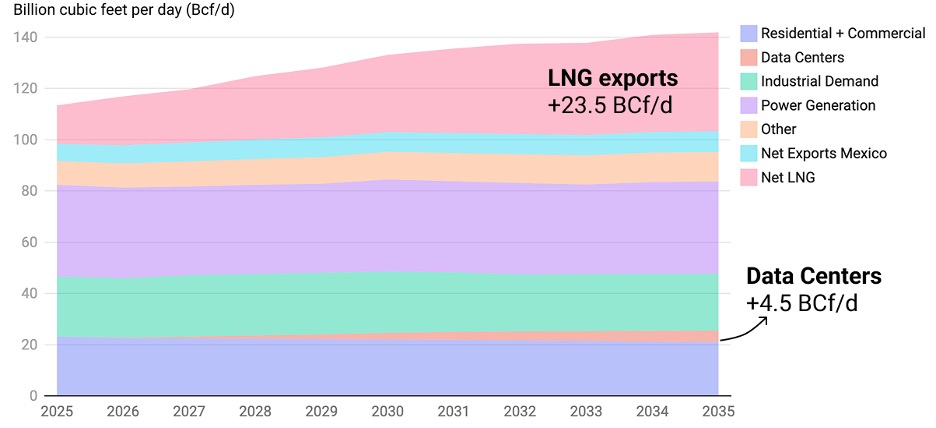
Source: Enverus Intelligence Research, EIA
LNG buildout comes for Appalachia gas
In the first half of 2026, US LNG exports grew at the fastest rate since the US began large-scale exports in 2016, averaging 17.4 Bcf/d in the first six months of the year, 23% higher than the same period in 2025. And that growth is set to continue over the next decade. Since the Trump administration ended Biden’s pause on new LNG export permits in 2025, projects with a combined liquefaction capacity of roughly 11.8 Bcf/d have reached final investment decisions (FID).
While the vast majority of new LNG capacity in the US is concentrated along the Gulf Coast, there is new evidence that developers are reviving efforts to build an LNG terminal near Marcus Hook in southeastern Pennsylvania, a location that would provide direct access to Appalachian gas.
Information obtained via right-to-know requests, filed by Delaware Riverkeeper, revealed that the developers behind the previously shelved “Penn America LNG” project have engaged in intense lobbying with state officials over the last year. Rebranded as Eddystone LNG, the proposed terminal would have a capacity of 7.2 million metric tonnes per annum (MMtpa) of LNG, or the equivalent of 950 MMcf/d, as well as 320,000 cubic meters of onsite LNG storage, sending out as many as four large LNG carriers per week. A new greenfield gas pipeline would be required to connect the proposed terminal to the TETCO interstate pipeline system.
The US LNG industry has garnered a lot of attention this year, since the start of the war with Iran, and the consequent disruption to global LNG trade. US natural gas prices remained largely insulated from major price increases seen in Asia and Europe, making projects like Eddystone LNG . Still, with nearly 17 Bcf/d of baseload LNG export capacity already under construction and 11 Bcf/d more approved but not yet under construction, the Eddystone LNG terminal would come online on the heels of the largest buildout of new capacity in history.
Data centers drive wave of new gas-fired capacity additions across Appalachia
Beyond LNG exports, surging data center demand is fueling a wave of announcements of new gas-fired power generation projects.
According to Global Energy Monitor’s Global Oil and Gas Plant Tracker, over 155.2 GW of gas-fired capacity additions have been proposed in 20 states that are connected to Appalachia via interstate gas pipelines. According to GEM’s database, around 29.6 GW worth of new capacity additions are under construction. 77.9 GW worth of projects are in the pre-construction phase, meaning they are actively moving forward in seeking government approvals, land rights, or financing. Projects that are announced but have not yet moved forward by applying for permits or seeking land or financing total 47.7 GW. Unsurprisingly, of the selected states, Pennsylvania, Ohio, and West Virginia top the list for high capacity additions, thanks to the close proximity to Appalachia’s gas industry.
Major interstate pipelines connect Appalachian gas with planned new gas-fired capacity additions
It is unlikely that all of these proposals for new gas-fired power generation tied to data centers will move forward. Nevertheless, the findings underscore how valuable Appalachia’s gas reserves are to the booming data center industry.
Where there is growth in US gas production, the output of natural gas liquids will rise. NGL exports reached 3.1 million barrels per day in 2025, feeding the petrochemical industry in China, Japan, Canada, Mexico, and elsewhere. As of July 31, 2026, Oil and Gas Watch was closely tracking 30 NGL processing, storage, export, and pipeline projects across the US, including the expansions of two gas processing facilities in Washington County, Pennsylvania and the expansion of the NGL export terminal in Marcus Hook, Pennsylvania.
Downstream infrastructure expansions will require new pipelines
The bottom line is that rising demand for gas is not happening in isolation – it is being reinforced by the buildout of new infrastructure that creates a need for more gas, and the pipelines to transport it. As LNG exports grow and new data centers count on gas-fired power generation, the infrastructure being built today is already fueling a new wave of investment in pipelines that will facilitate production expansion in Appalachia.
At least fifteen pipeline projects are under development to boost takeaway capacity out of the Appalachian basin. Transco recently announced the Leidy Access project, which has a relatively small footprint but which will greatly increase capacity to transport gas from northeast Pennsylvania to the mid-Atlantic. The Leidy Access project adds to the list of dozens of expansion projects pursued by the Williams Company, the owner of the massive interstate system, designed to debottleneck routes and allow more gas to flow from Appalachia to the Northeast and Southeast.
Meanwhile, Boardwalk has expanded its Borealis pipeline proposal significantly. The planned pipeline would consist of two legs, a 200-mile-long, 2 Bcf/d “supply leg” from the Clarington hub in southeastern Ohio to Lebanon, Ohio. The company now proposes to build an approximately 264 mile “mainline leg” alongside the existing Texas Gas Transmission system from Lebanon, Ohio to Slaughters, Kentucky.
Boardwalk has yet to file an application with FERC, but the pipeline has already sparked protests among landowners and concerned communities in Kentucky. The company expects to initiate the pre-filing process with the federal regulatory agency in the next five months. If the project moves forward, it would be the first significant greenfield pipeline built since the controversial Mountain Valley Pipeline, and it would represent a major debottlenecking of gas flows out of Appalachia towards the Midwest and beyond.
Regulatory rollbacks proposed by FERC earlier this year could make it easier for pipeline developers to obtain blanket authorizations for significant intra- and interstate expansions, thereby bypassing case-by-case scrutiny, important environmental reviews, and community oversight.
Every new proposal to build a pipeline, LNG terminal, or gas plant risks locking in new demand sources for decades to come.
Selected pipeline projects to boost takeaway capacity out of Appalachia