


This analysis is an expanded and updated version of an earlier presentation to the Ohio River Valley Institute.
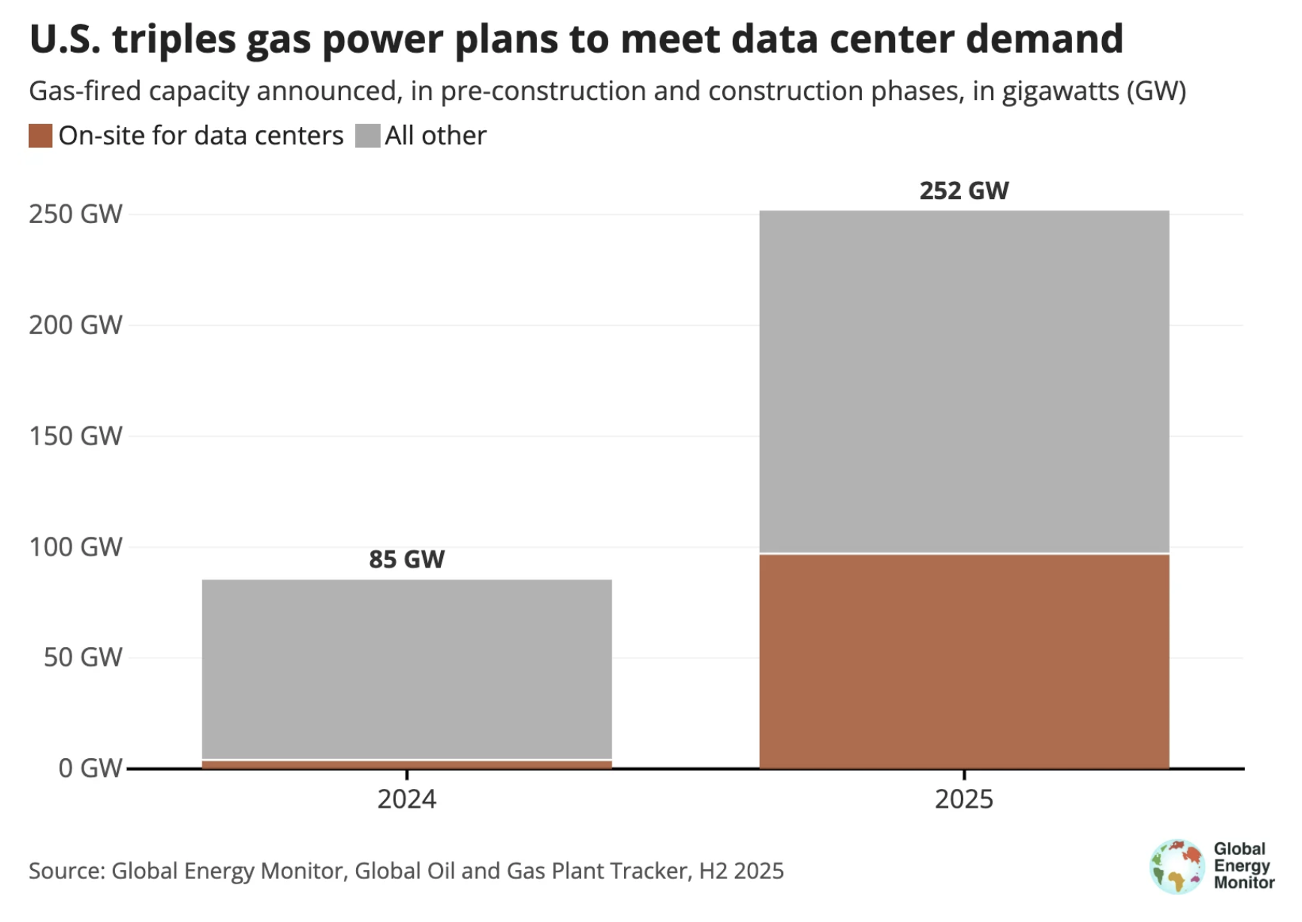
A new report describes the exponential rise in the development of gas-fired power in the US, primarily for data centers. According to Global Energy Monitor, the US nearly tripled its gas-fired capacity in development in 2024, totalling almost 252 gigawatts (GW), a volume roughly equivalent to the sum of plans for China, Vietnam, Taiwan, and South Korea. If all in-development plants are built, the US’s existing gas fleet would grow by nearly 50%. More than one-third of gas-fired power generation capacity under development in the US is slated to serve data centers on site, or “behind-the-meter.”
Data center expansion is one of the single-most important drivers of new gas demand in the US, and is evidenced by a new trend of Big Tech entering long-term contracts with gas companies to supply on-site power generation. The top five hyperscalers announced plans to spend $700 billion in 2026, driven by AI and data center development. This development means significant new demand for electricity, much of which will be supplied by gas. Though exact figures on data center expansion are difficult to nail down, several long-term agreements have made national headlines.
Much of this growth is slated for Appalachia: 8.8 GW of on-site (behind-the-meter) gas-fired power generation is at various stages of development in Pennsylvania, all of which would be fueled by Appalachian gas.
Data center growth in other parts of the country could also mean increased gas production in Appalachia. For example, many of the new gas power plants coming online in Virginia, North Carolina, South Carolina, Georgia, and Alabama to replace older plants (including coal-fired ones) could be serviced by gas produced in Appalachia thanks to new pipeline capacity under development (i.e. MVP and several projects along or near Transco and Tennessee Gas Pipeline systems).
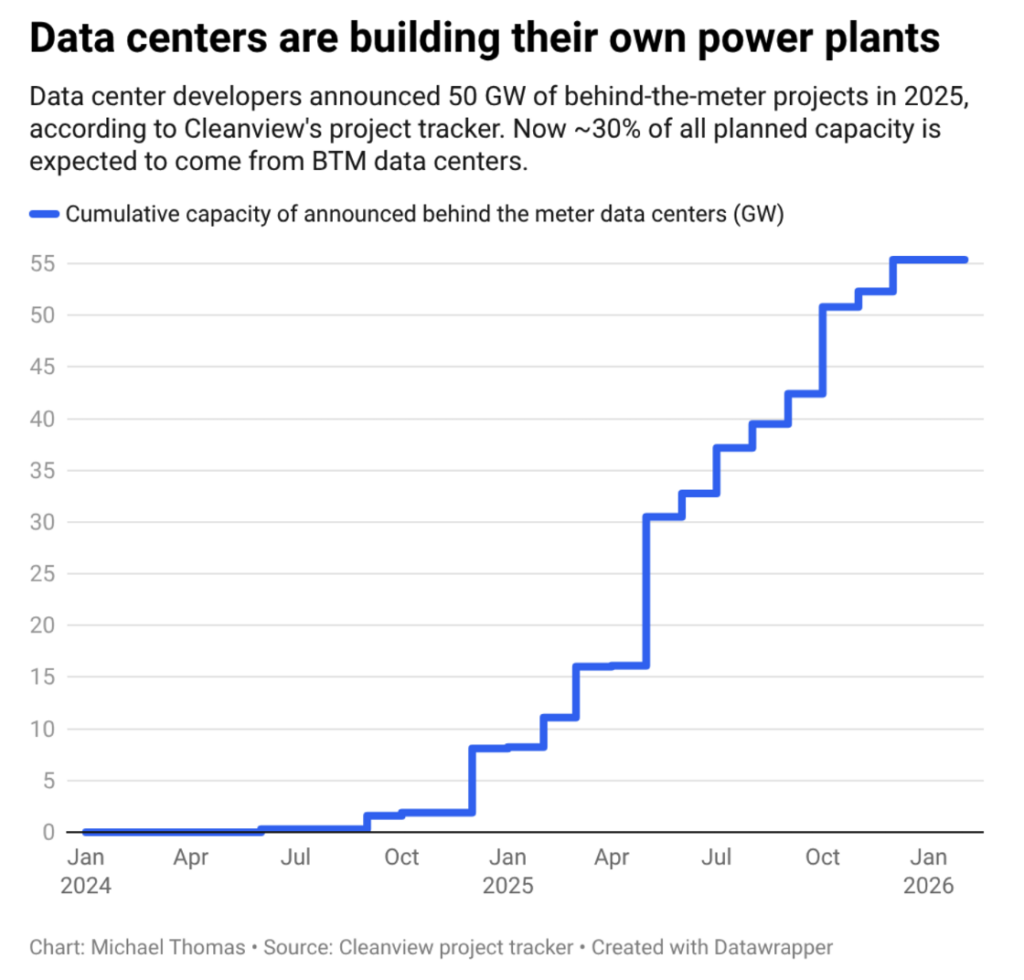
Global Energy Monitor’s findings mirror other recent studies, including a new report released by Cleanview in January 2025. According to Cleanview’s study, more than 50 GW of behind-the-meter projects were announced in 2025, including 7.5 GW in Pennsylvania, 2 GW in West Virginia, and 1.1 GW in Ohio.
Long-term growth
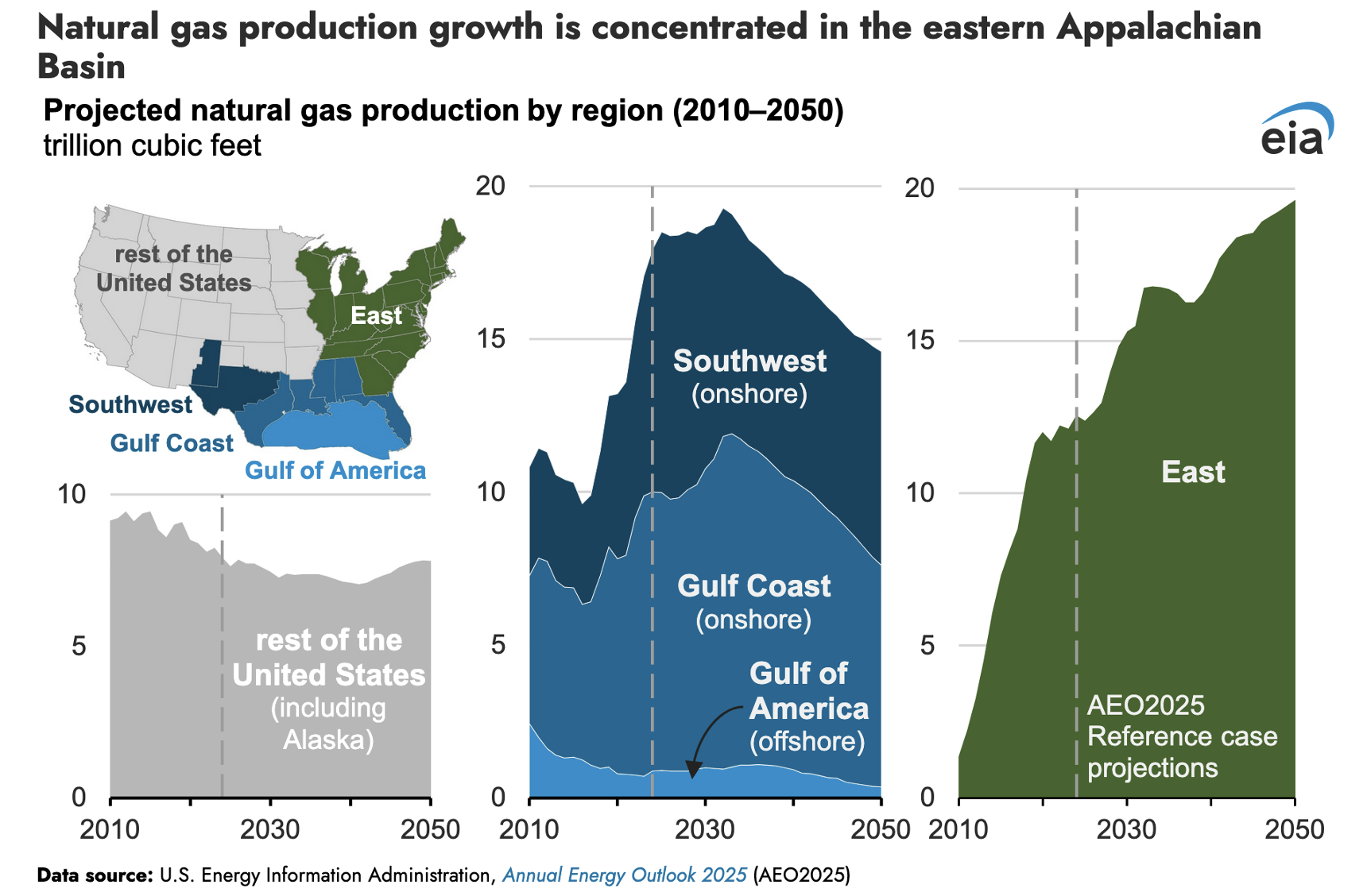
According to the Energy Information Agency’s latest Annual Energy Outlook, Appalachian gas production is expected to increase substantially from 37 Bcf/d in 2025 to between 66 Bcf/d and 73 Bcf/d by 2050. Appalachian gas could account for nearly half of all natural gas produced in the US. This Appalachian gas production would increasingly meet gas demand across the US in the coming decades, including the massive LNG buildout and ensuing demand growth along the Gulf Coast. EIA describes several reasons for this demand growth.
Associated gas production linked to crude oil in the Permian is expected to decline over the same period. The Haynesville basin, where production has grown recently thanks to its proximity to the Gulf’s LNG terminals, is deeper and will be increasingly more expensive to drill, limiting its longer-term outlook.
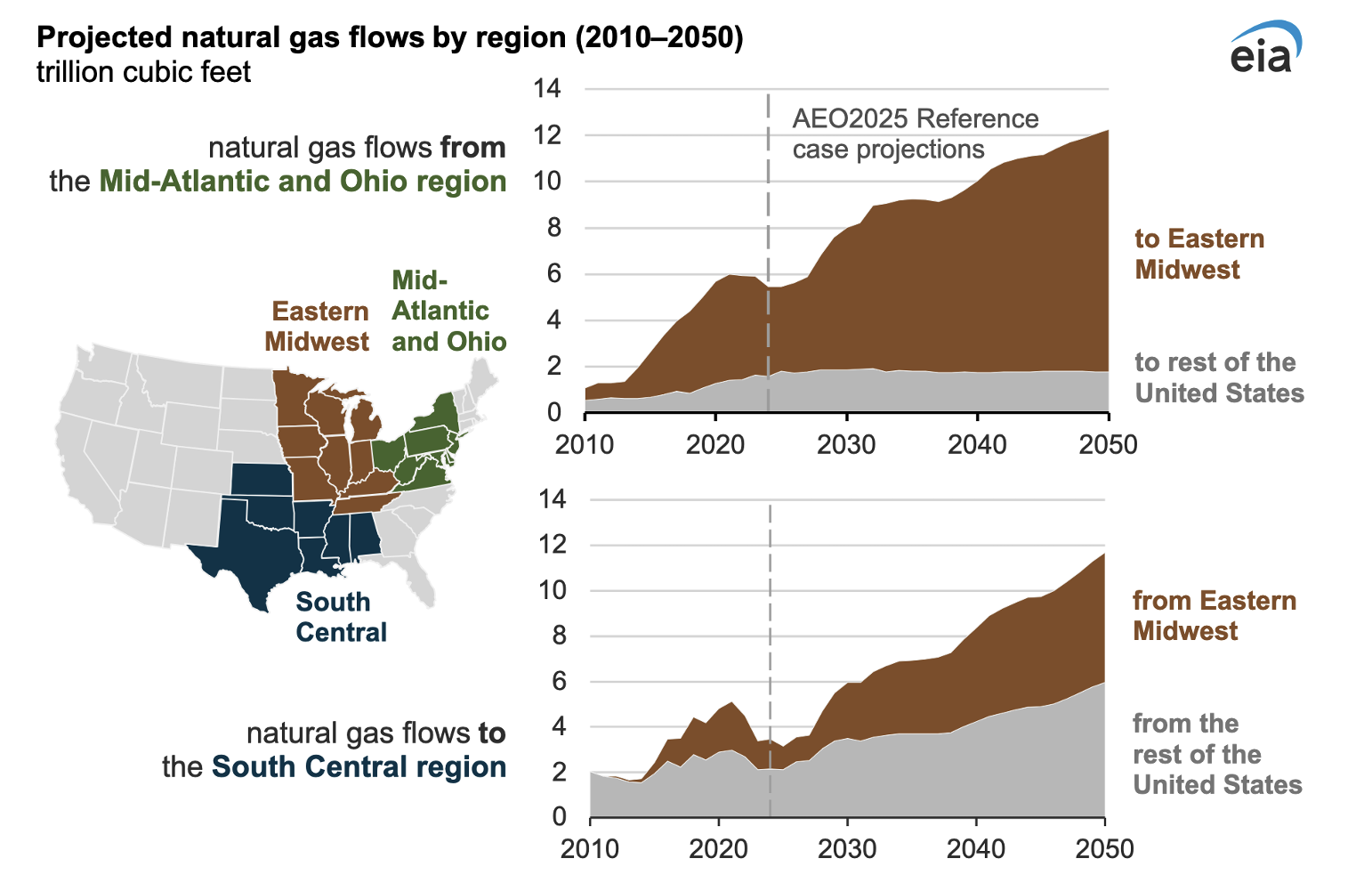
EIA expects that as Appalachian gas production increases and as gas prices continue to rise along the Gulf, significantly more gas will flow between the Mid-Atlantic and Ohio region (Appalachia production zones) to the Midwest. At the same time, the volume of gas moving from the Midwest region to South Central increases significantly as it becomes more favorable for midstream companies to invest in pipelines and associated infrastructure to transport cheaper Appalachian gas to the Gulf.
This illustrates how Appalachian gas will increasingly flow south through the Midwest to meet LNG demand on the growth, as well as growing gas demand centers in the Southeast. The dramatic increase of gas flows from Appalachia into the Midwest and from the Midwest into South Central will necessitate pipeline development to increase takeaway capacity out of Appalachia.
LNG capacity ramps up
LNG exports are contributing to all-time high residential electricity rates and LNG capacity is set to grow even more. Three new LNG export facilities are driving this year’s growth: Plaquemines LNG, Corpus Christi Stage 3, and Golden Pass LNG. Meanwhile, five additional LNG export projects in the US reached financial investment decisions (FID) and are currently under construction: Golden Pass LNGPort Arthur LNG, Rio Grande LNG, Woodside Louisiana LNG, and CP2 LNG. LNG export capacity could reach as much as 21.1 Bcf/d (25.2 Bcf/d peak) by 2028 from just the first three projects.
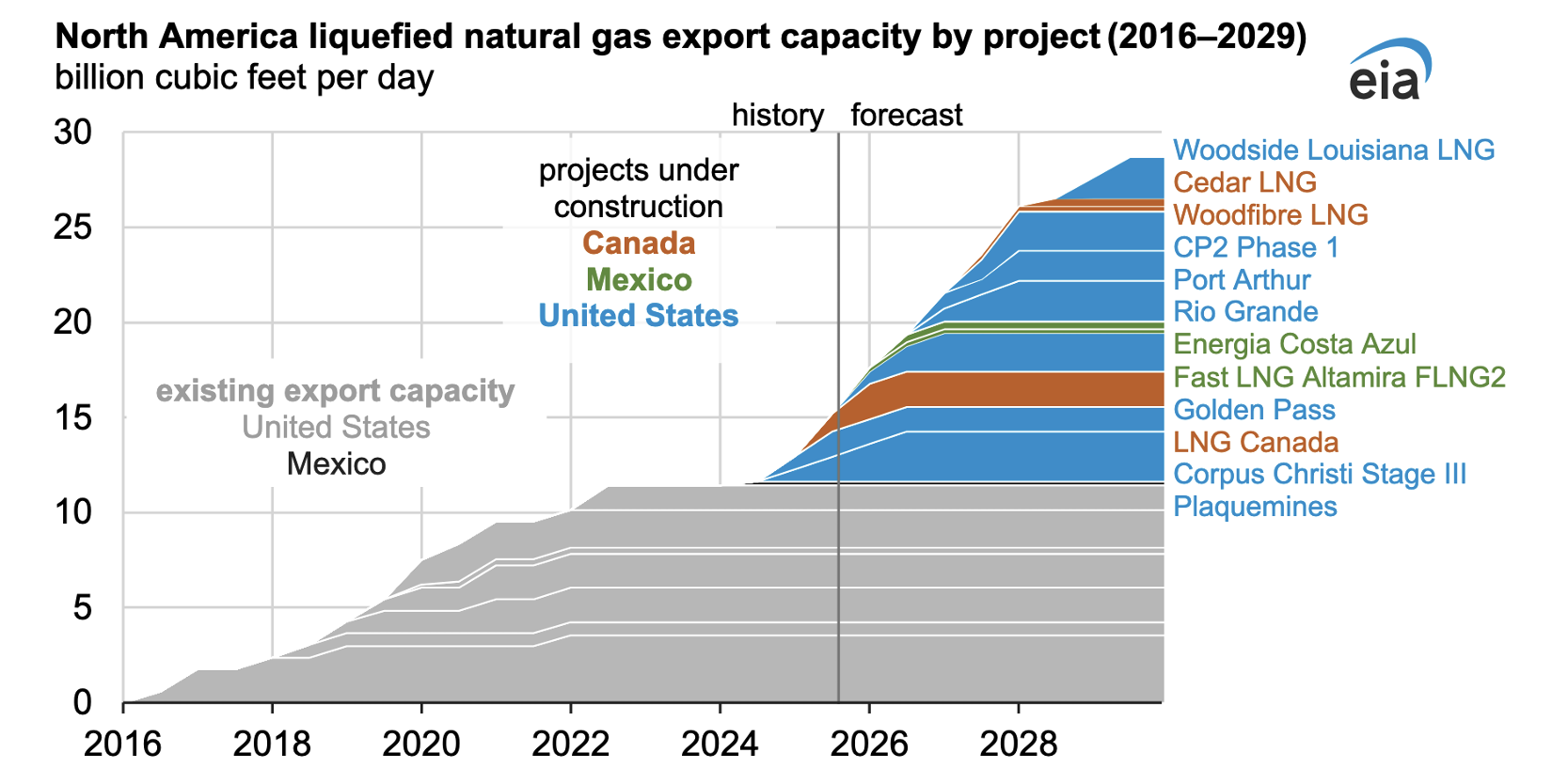
At the same time, top Appalachian gas producers, including EQT and Wjlliams, have secured contracts with LNG terminals on the Gulf to buy LNG and sell it directly to customers in Europe and Asia. After buying cargoes from the terminals, the companies can sell them to Europe and Asia at higher prices than they can get in the US. These purchase agreements represent a major expansion for these gas companies, allowing them to control more of the supply chain and to capture the price spread between US domestic gas and international prices.
Capital spending by the 13 largest midstream companies rose 14% in 2024 and 20% in 2025, representing a rebound in midstream investment followed by a period of restraint after 2020, as reported by industry analyst RBN Energy. Most of the gas supply for LNG terminals along the Gulf will come from the Permian and Haynesville basins in the near term; however, Appalachian gas will meet much of the demand growth from power generation and data centers.
Pipeline buildout meets sluggish growth
Appalachian gas production has been hovering between 34 and 36 billion cubic feet per day (Bcf/d) since 2020 due to constraints from limited pipeline takeaway capacity. Since then, however, Appalachian gas production grew 2.1 Bcf/d from 2024 to 2026, largely thanks to the June 2024 startup of the Mountain Valley Pipeline (MVP). MVP directed up to 2.0 Bcf/d of gas from northwest West Virginia toward the Southeast and now two MVP expansion projects are in development: the MVP Boost, which would increase the mainline capacity to 2.6 Bcf/d, and the MVP Southgate project, which would extend the MVP mainline from its terminus in Pittsylvania County, Virginia to new interconnections in Rockingham County, North Carolina.
Pipeline projects are also slated to expand capacity and de-bottleneck interstate corridors. Examples include a slew of expansions along the Transco interstate pipeline, the Appalachia Reliability project along the Eastern Gas Transmission system, and a series of projects along the Texas Gas Transmission system.
Boardwalk’s Borealis pipeline would extend the Texas Gas Transmission (TGT) pipeline across Ohio, expanding Appalachian gas producers’ access to customers in the Midwest and Gulf Coast. The project is designed to work in concert with Boardwalk’s expansion plans elsewhere on the TGT system, an interstate pipeline that spans eight states from Ohio to Louisiana. FERC is reviewing the Kosci Junction project, a 1.6 Bcf/d capacity pipeline that would extend the TGT system across Mississippi, terminating at Transco Station 85. If Boardwalk completes both the Borealis and the Kosci Junction projects, it would be the first time the Clarington hub in Appalachia would directly connect to the premium Station 85 market, on the border of Mississippi and Alabama.
Near-term uncertainty
Even though national trends indicate that natural gas production in Appalachia is likely to grow in the coming decades, the immediate outlook is a murkier prospect.
Nearly every major player in the Marcellus and Utica gas basin discussed expectations for higher gas demand from new power generation in and near their production areas, with the majority of anticipated power generation being tied to planned data centers.
For example, Appalachia’s largest producer, EQT, will supply 665 MMcf/d of gas to a planned 4.4 GW power station in Homer City, and 800 MMcf/d to a 3.6 GW power plant in Shippingport, PA, each of which will support large data center campuses. NextEra Energy and Google announced plans to partner in multiple sites across the US to scale hyperscale data center campuses with on-site power generation. Likewise, Williams is developing three major gas plants in Ohio to fuel Meta’s hyperscale complexes.
At the same time, EIA predicts Appalachian production will see modest growth in the near term, rising 0.4 Bcf/d in 2026 and 0.7 Bcf/d in 2027. EIA’s latest Short-Term Energy Outlook does not adequately account for the emerging trend of recent data center-related increase in planned gas-fired power capacity but it’s unlikely that all of the proposed data centers in the US will move forward, making it difficult to understand the short-term impact on gas production in Appalachia.
A recent analysis from Aurora Energy Research determined that potentially two thirds of announced data center capacity was “speculative”, meaning that these developers have yet to secure site control, obtain permits, or don’t have active interconnection requests. The bulk of the remaining planned capacity is associated with “newcomers”, or companies with no current operational capacity, which calls into question just how much of the new gas-fired power capacity assessed by the Global Energy Monitor will actually materialize.