

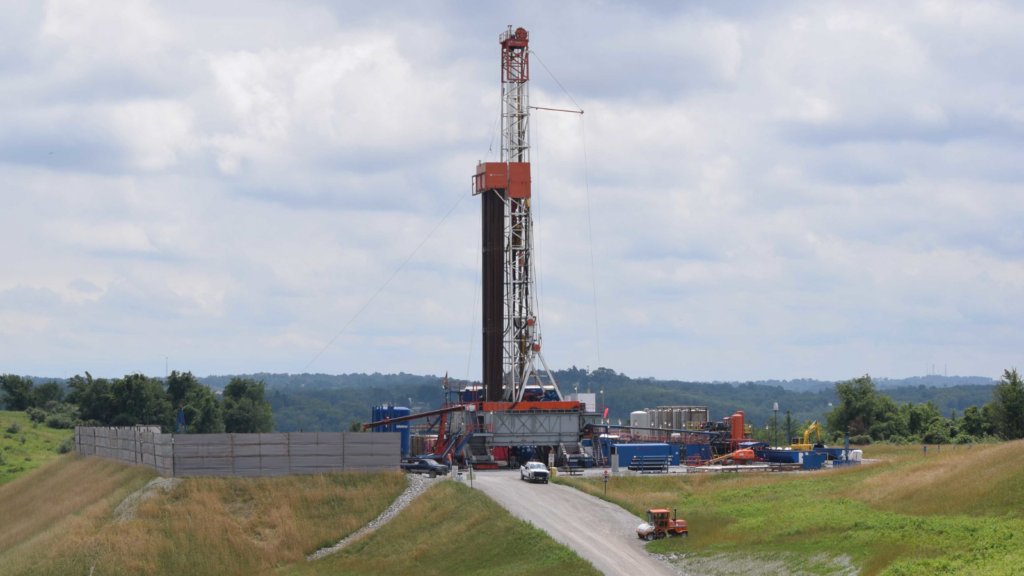
Time may be running out for Pennsylvania to benefit from the “shale gas boom” and to clean up the hundreds of thousands of abandoned wells that litter the state’s landscape.
Over the last few years, shale gas production in Pennsylvania has stagnated after growing substantially for over a decade. It is highly uncertain how much shale gas remains, but a good portion of the economically recoverable shale gas may already be exhausted and production may begin its eventual decline over the next several years.[1]
Unfortunately, policymakers in Pennsylvania have placed little emphasis on ensuring the state benefits from shale gas over the long run, or on securing the money needed to clean up well sites after they reach end of life. The state’s small fee on shale development has only produced a fraction of what most states receive from their finite natural resources.
The good news is that there is time to take meaningful action before Pennsylvanians are left with billions of dollars in cleanup costs, deteriorating infrastructure, and more economically distressed communities. Adequate taxation on shale gas could provide a source of long-term income for the state, boost oil and gas jobs in remediation, and improve economic development while stopping toxic leaks that poison the air and water. Funds could also go toward addressing about $20 billion in liabilities associated with the state’s unplugged wells.
Pennsylvania Lost Over $5 Billion in Shale Gas Revenue
By choosing to assess an impact fee per new gas well rather than assessing a severance tax based on wellhead production value, Pennsylvania has forgone billions of dollars in revenue since the shale boom. From 2011 to 2025, Pennsylvania collected $3.1 billion in revenue from its impact fee. Over the same period, West Virginia collected $3.3 billion in severance tax revenues while producing only 38% as much gas as Pennsylvania. While gas production has plateaued in Pennsylvania, it has grown by a third in West Virginia over the past five years.
Had Pennsylvania collected a comparable amount in severance taxes per unit of production — roughly 10 cents per thousand cubic feet of natural gas equivalent — it could have generated an additional $5.6 billion in revenue. This money would be enough to clean up the state’s 50,000 documented orphaned and abandoned wells while providing thousands of blue-collar jobs.
The gap doesn’t end there. Unlike West Virginia, Pennsylvania does not levy a property tax on natural gas and oil, meaning local governments have forfeited several billions of dollars in additional revenue on top of lost severance taxes. West Virginia collected $123 million in natural gas and oil property taxes in 2024.
Another Missed Opportunity: Building Long-Term Wealth for Pennsylvanians
Beyond the failure to establish a severance tax, Pennsylvania also did not follow other resource-rich states in establishing a permanent severance tax trust fund or sovereign wealth fund. Most western energy-producing states have created trust funds from non-renewable resource revenues, drawing on dedicated severance taxes. In addition to trust funds financed by severance taxes, many states also have public land-based funds that generate a substantial portion of revenues from oil and natural gas leases to fund universities, schools, and other state priorities. Texas, for example, has two land-based trust funds with a combined balance of over $100 billion.
North Dakota, which experienced a parallel shale boom in oil at roughly the same time as Pennsylvania’s gas boom, established its Legacy Fund in 2010 using production taxes on oil and natural gas. That fund now holds $14.5 billion, roughly $18,000 per state resident. Had Pennsylvania created a trust fund with a 5 cent per Mcfe tax, it would hold about $5.7 billion in assets today.
Severance Taxes Good for State Economy
Research shows state severance taxes have little impact on production levels while generating substantial revenues and boosting local employment. No state has ever lost a lot of production as a result of enacting a severance tax — because these taxes make up a small portion of production costs and are largely passed on to out-of-state consumers.
In fact, most of the tax responsibilities would likely flow out of Pennsylvania, much like 75% of the shale gas already does. A severance tax would also keep more of the production value circulating in the state, funding infrastructure, well plugging, and other public investments that support local jobs. Structuring the tax as a tiered rate tied to commodity prices would further ensure that revenues are collected when producers are operating above “break-even” prices and are best positioned to pay.
Conclusion
The oil and gas industry has praised Pennsylvania’s impact fee as a success story. A more accurate verdict is that it has been a missed opportunity – one that has sent billions of dollars out of the state that could have benefited Pennsylvanians. Other states and countries, including Norway, recognized early on that smart stewardship of finite fossil fuel resources means putting the long-term interests of residents first.
If Pennsylvania is serious about putting its residents first, adopting a severance tax, establishing a permanent fund, and dedicating those revenues to plugging abandoned wells, repairing infrastructure, and investing in distressed communities is a straightforward choice. Some lawmakers are already moving in that direction and have introduced legislation (SB 919 and HB 2129) to enact a severance tax before it is too late. The question is whether Pennsylvania will act, or keep wondering where all the money went.
[1] Saputra et al. finds that the Estimated Ultimate Recovery for the Marcellus Region (primarily WV and PA) to be approximately 200 Trillion Standard Cubic Feet. Approximately 50.4 Tcf was produced by 2020, with 40 Tcf left in proved reserves and 109 Tcf in remaining resources, for a total remaining recovery of 149 Tcf from 2021 to 2050. From 2021 to 2024, total shale production in PA and WV was approximately 41 Tcf, so this leaves 108 Tcf of the remaining of the 200 Tcf in estimated ultimate recovery. In 2024, PA accounted for 68% of shale production in WV and PA, so there may be 73.8 Tcf in estimated future production or 48% of the estimated ultimate recovery of 142 Tcf in PA. US EIA finds 69.5 Tcf of proved producing reserves and 35.6 proved nonproducing reserves in PA, for a total of 95.1 Tcf of total proved reserves (all gas reserves) at the end of 2024. Between 2008 and 2025, PA produced 82.5 Tcf of shale gas or 46% of total 2024 estimated proved reserves in 2024.